No. Starlink doesn’t keep existing customers on old prices. After the May 2026 increase, existing customers paid the new prices on bills on or after June 18, 2026, about a month after new orders. In November 2026, after Starlink moved Residential to prices set by address, press reports say some existing customers have been emailed increases of up to about 20% (for example Max from $130 to $156), while some areas get cuts. A new price starts with the first billing cycle on or after the date in Starlink’s email. We haven’t found a Starlink policy that protects month-to-month customers from future changes, so plan as if the next one will reach you too.
What happened in November 2026
Since late October 2026, Residential is set by your service address: starlink.com shows Residential prices only after you enter one (since late October 2026). There’s no single national price any more:
| Plan | One national price until late Oct 2026 | Levels in Starlink’s own price data since Oct 29, 2026 |
|---|---|---|
| Residential 100 Mbps | $55 | $44–$55/mo |
| Residential 200 Mbps | $85 | $68–$85/mo |
| Residential Max | $130 | $104–$156/mo |
Existing customers are being moved too. Press reports from Nov 8–9, 2026, citing PCMag, say some existing customers have been emailed increases of up to about 20% (for example Max from $130 to $156), while some areas get cuts. The emails started in Kansas, Missouri and Nebraska and then reached Virginia, Louisiana, North Carolina, Washington and Alaska. Some summaries cite a Nov 30 effective date; we couldn’t read them directly. The date that counts is the one in your own email: your new price starts with the first billing cycle on or after it.
What that does to a year: a Max customer moved from $130 to the top level in Starlink’s data, $156/mo, pays $312 more a year. A customer in an area that gets a cut pays less. Your email and your account are the only places that show which one you are.
What happened in May 2026
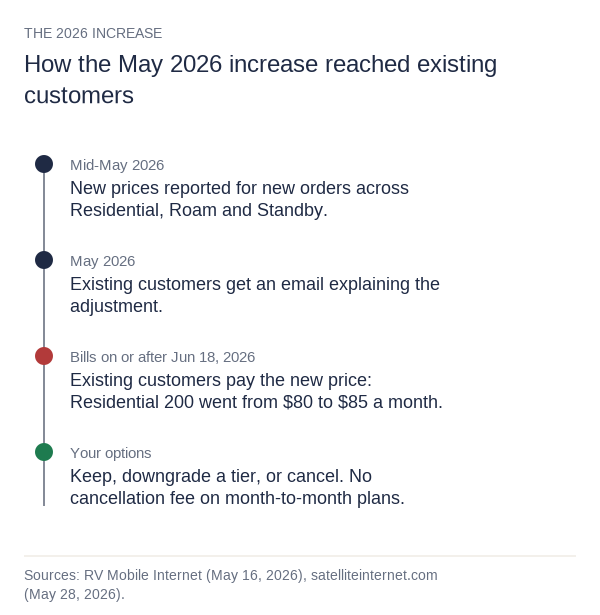
Mid-May 2026. New prices were reported across Residential, Roam and Standby for new orders (RV Mobile Internet, May 16, 2026).
May 2026. Existing customers received an email explaining the change. Coverage quoted Starlink describing it as an adjustment that “supports ongoing improvements and investment in affordable, high-performance products and services as global operating costs continue to rise” (ISPreview). satelliteinternet.com (May 28, 2026) reported the email as the notification method and didn’t specify a notice period.
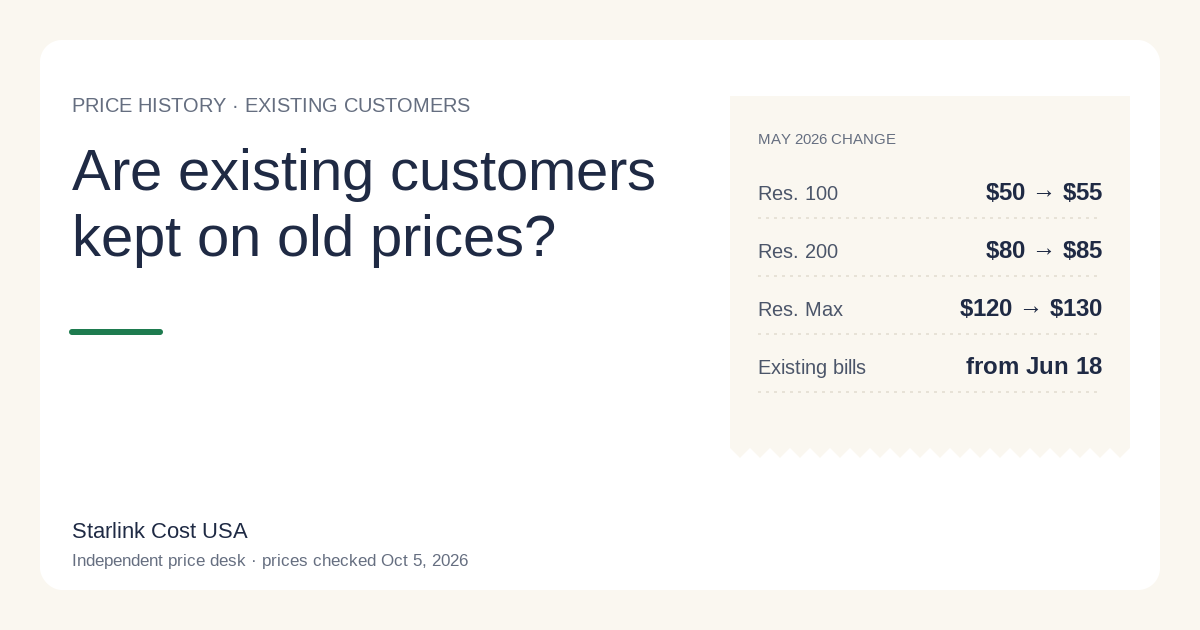
Bills on or after June 18, 2026. Existing customers paid the new prices.
What the May change did to yearly bills
| Plan | Old price | New price | Extra per year |
|---|---|---|---|
| Residential 100 Mbps | $50 | $55 | $60 |
| Residential 200 Mbps | $80 | $85 | $60 |
| Residential Max | $120 | $130 | $120 |
| Standby | $5 | $10 | $60 (if on Standby all year) |
The new column was the last national price list, in effect until late October 2026. Today the Residential lines depend on your address (see the table above); Standby is $10/mo (checked Nov 16, 2026).
Earlier changes
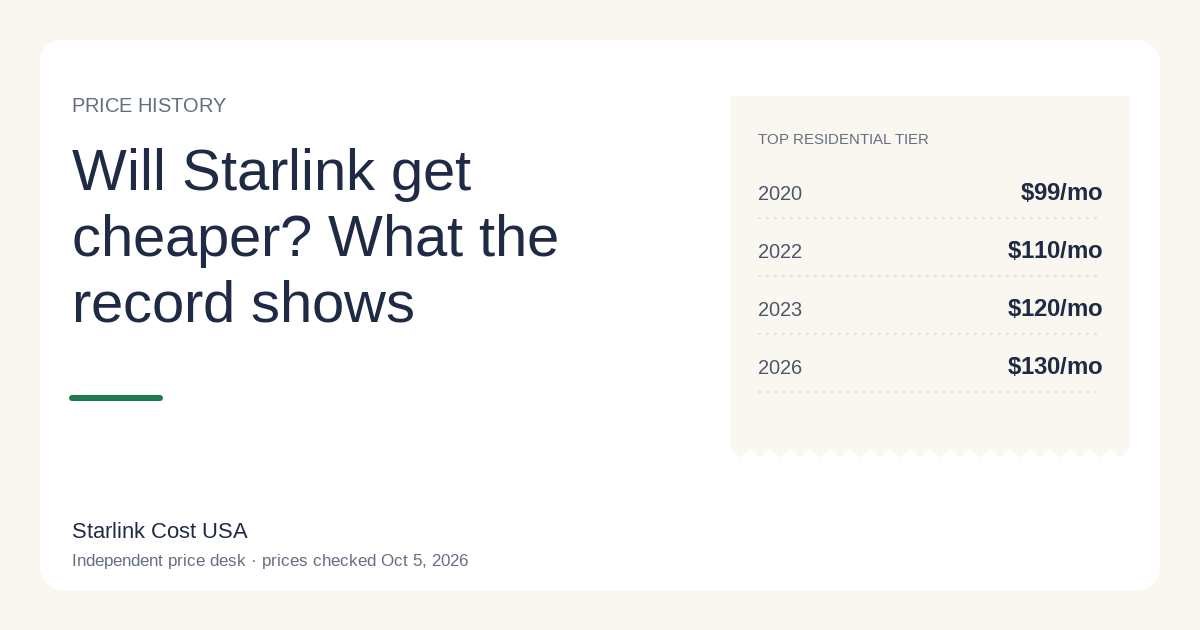
Our price history records earlier increases in 2022 (the top tier from $99 to $110) and 2023 (to $120 in limited-capacity areas). We don’t have reliable records of how each one reached existing customers, so we don’t claim a pattern beyond 2026. Until October 2026 we had no record of the top tier’s national price going down. Address-based pricing changed that: some addresses now see Max below its old national price and some above it.
Renamed plans: did anyone lose a cheaper plan?
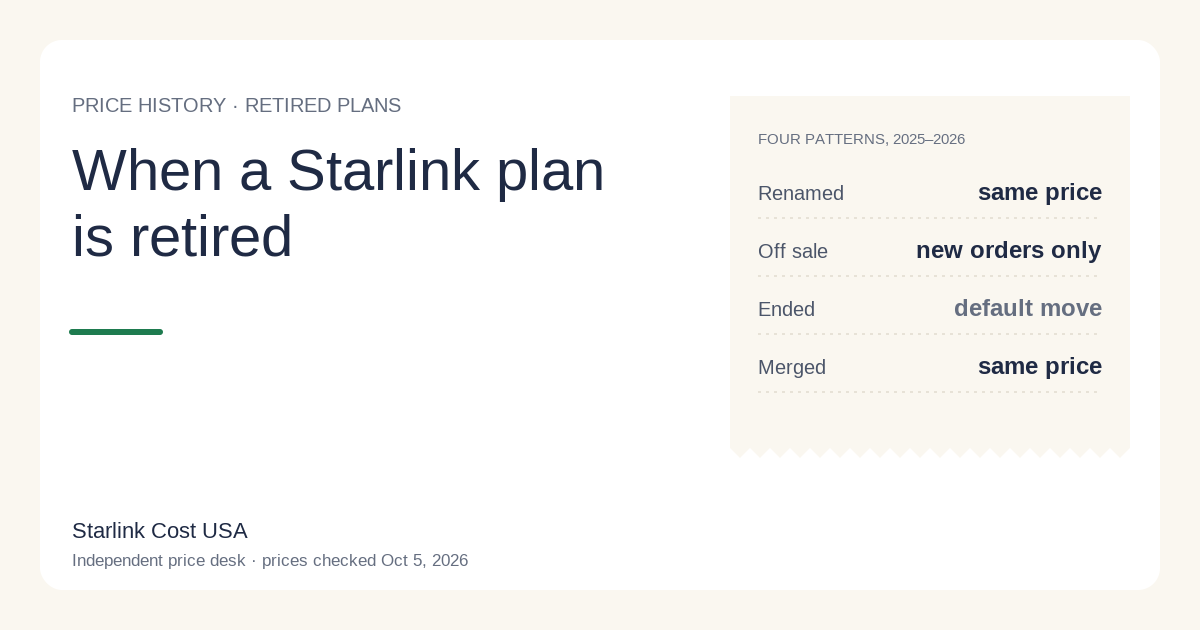
In January 2026 the plans were restructured: the old Residential became Residential Max, Residential Lite became Residential 200 Mbps, and a new Residential 100 Mbps tier arrived. The renames kept their prices at the time ($80 and $120). The increase came four months later. If you’re reading an old article that mentions “Residential” at $120 or “Lite” at $80, those are the 2025 names and prices.
Can you lock in a price?
On a month-to-month plan, we haven’t found a way. Commitment offers work differently: there’s a Change Fee ($249 or $325 under Starlink’s US terms) if you leave a commitment offer early; the $0-kit 12-month commitment is closed to new activations. If a commitment offer ever shows at your checkout, it only protects you if its text explicitly fixes the monthly price for the term. Check three things: whether the price is guaranteed, what leaving early costs, and whether you can still downgrade during the term.
New customers in select areas may see a November discount at checkout (30% off recurring Residential service in Starlink’s own text, for sign-ups by Nov 30, 2026), and a Starlink rep told PCMag it has “no scheduled expiration” (via RV Mobile Internet), which still isn’t a price lock; the math is in what each plan costs after the discount.
Your options when a notice arrives
- Check the effective date in the email and your account, so you know which bill changes.
- Recalculate your year. New price × 12, plus tax. Use the price in your email. For scale: at the $76.50/mo level starlink.com lists for Residential 200 Mbps before an address is entered (Nov 16, 2026), a year is $918 before tax.
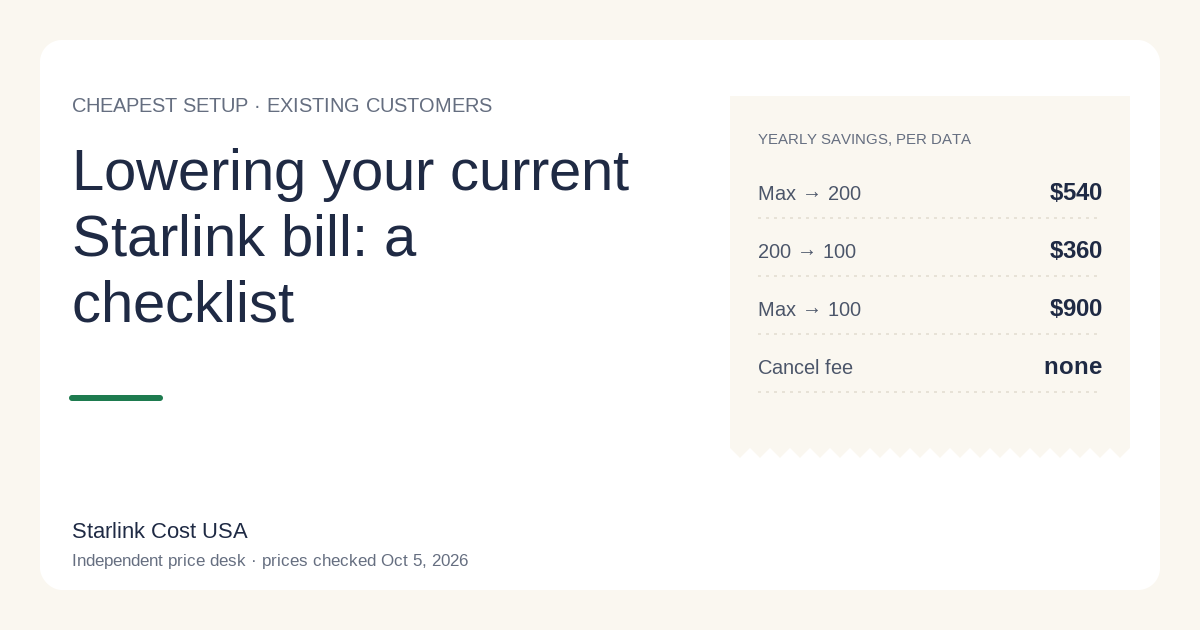
- Consider a downgrade. Each tier’s price is set by address, so compare your own numbers. At the levels starlink.com lists before an address is entered (Nov 16, 2026), Max to 200 Mbps saves $798 a year, and 200 to 100 saves $324 where 100 is offered. Leaving Max also ends its extras (a Starlink Mini rental with no monthly fee and 50% off eligible Roam plans). A plan change can add a prorated line and, in busy areas, a surcharge (one-time, in high-demand areas, when you buy service, activate a new plan or move your service address into one; refunded with a 30-day return).
- Compare alternatives that may have arrived since you signed up: fiber, cable, 5G. See when Starlink is the wrong buy.
- Cancel if it no longer makes sense. There’s no cancellation fee on month-to-month service; time it before the first bill at the new price. Rentals must go back within 30 days. Details in is there a Starlink cancellation fee?
Is a price-change email real?
Scammers copy billing emails. Before acting on any notice:
- Don’t click payment links in the email. Log in to your account by typing starlink.com yourself.
- Check whether the new price shows in your account.
- Compare with our price news, where we log each change with a date and source.
More warning signs in fake Starlink sellers and too-cheap listings.
Worked example: a household on Residential Max
Before late October 2026 they paid the national $130: $1,560 a year. Their November email moves them to $156/mo, the example in the press reports: $1,872 a year, or $312 more.
If they downgrade to Residential 200 Mbps instead, and their address gets the $76.50/mo level starlink.com lists before an address is entered (Nov 16, 2026), their year costs $918, which is $642 less than they paid before. Their address may put 200 Mbps anywhere in $68–$85/mo, and they’d give up Max’s extras. Whether 200 Mbps is enough is their call; the tier comparison helps.
How a price change lands on a mid-cycle bill
A new price takes effect from a billing cycle, not from the day you read the email: Starlink’s rule is the first billing cycle on or after the date in its email. In May 2026 that date was June 18. So:
- If your billing date was June 10, your June 10 bill was still at the old price, and your July 10 bill was the first at the new one.
- If your billing date was June 20, that June bill was already at the new price.
That’s why two neighbors who got the same email can see the change a month apart. If you’re deciding whether to downgrade or leave before the new price hits, act before the first billing cycle that starts on or after the effective date, and allow a few days for the invoice to be generated.
A notice checklist
When any price-change notice arrives, write down five things:
- The effective date and which of your bills it applies to.
- Your current plan name and price, from your account, not memory.
- The new price for your plan, and for the tier below it.
- Any change to Standby or rental fees if they apply to you.
- The date you read it, with a screenshot.
With those, you can recalculate your year in two minutes and compare against a downgrade. Without them, you’re relying on a bill you haven’t seen yet.
What we don’t know
- Starlink’s notice period in writing. We know the billing rule (the first cycle on or after the date in the email), not a minimum number of days.
- Which price level your address gets, and whether your next email brings a rise or a cut.
- The exact effective date of the November 2026 emails. Some summaries cite Nov 30; your email is the source that counts.
What to do next
- Note your current plan and price from your account, with a dated screenshot.
- When a notice arrives, run the numbers in the calculator and check the downgrade option.
- Bookmark the price history to see when the next change lands.
Not ordered yet? Residential prices are set by address now, and new customers see their own address’s price, plus any discount it qualifies for, at checkout. See yours on starlink.com, and run it through the calculator.